The nature of invisible dark matter (DM), which constitutes ~26% of the mass-energy balance of the Universe, remains a major
puzzle in physics. Despite extensive searches, DM constituents remain undetected, though experiments have significantly constrained
the allowed parameter space. The NEXUS project aims to advance this research by enhancing detector performance, refining instrumentation,
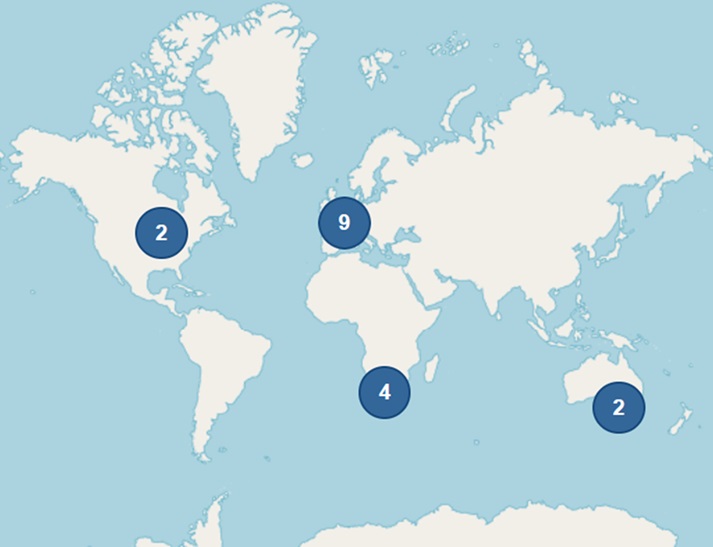
and expanding theoretical insights through a sustainable expert network. Partnering with world-class laboratories in Europe, the USA,
Canada, Australia, and South Africa, NEXUS will tackle extraordinary experimental and theoretical challenges. This research relies on Underground
Laboratories, where cosmic rays are suppressed by ~1000 meters of rock, minimizing the cosmogenic backgrounds.
WP1
Low background technologies
WP1 focuses on low-background technologies and procedures to reduce radioactive contamination and improve
screening, material selection, and protocols for underground experiments.
The Deep Underground Labs (DULs) have provided material characterisation measurements to a substantial number of experiments over a number of years whilst R&D and knowledge exchange has helped to increase sensitivity and uniformity in this time. As we move toward the next generation of low-background particle physics project, such as large-scale dark matter or neutrinoless double beta decay experiments, the throughput and sensitivity needed will increase further. The expertise acquired by scientists of the underground laboratories allows them to develop in the DULs radiopure materials when a commercial alternative is not available: this is the case for interposers for electronic circuits. The standard printed circuit boards (PCB) are based on relatively radiopure epoxies reinforced with fiber fabrics (glass, kevlar, carbon, liquid crystal elastomers).
These fabrics, even when based on clean materials, are strongly contaminated by radiogenic elements, given their high exposed surface. Most experiments use polyimide derived substrates (CIRLEX): while the substrate is radiopure, the PCB is typically contaminated with lead during the production. Furthermore, polyimide has very bad adhesion and no rigidity, both causing problems in the use. Interposer techniques based on metal film deposition on radiopure substrates(like fused silica) are more promising for the electronic circuits of future low background experiments. Furthermore, it will be possible to produce non-planar radiopure circuits by integrating the most modern additive manufacturing techniques for alumina/zirconia and the film deposition facilities that are being planned at INFN (LNGS). The main Objectives are:
O1.1: DUL background reduction and mitigation strategy
O1.2: Reinforce and innovate the development of assay techniques
O1.3: Exploiting pulse shape discrimination to improve gamma spectrometry sensitivities
O1.4: Define protocols for building radiopure electronic circuits
Timeline
WP2
Muography, Neutrons and radiation measurements
WP2 addresses underground background characterization, including neutron and radiation measurements,
and site-related studies relevant to underground laboratories. A key aspect of this WP will involve characterizing underground laboratories (ULs), using muography techniques. This is steadily becoming a monitoring tool for underground environments due to its leap in robustness, reliability, imaging performance and cost-efficiency. To characterize ULs, it is also of great importance to monitor the environmental radioactivity (gamma rays’ emission) and radon exhalation and concentration inside underground tunnels. The other aspect is the neutrons which are another critical source of background that requires careful control and understanding The main Objectives are:
O2.1: Underground Muons Measurements with electronic detectors and nuclear emulsion
O2.2: Underground Neutrons Measurements with electronic detectors and nuclear emulsion
O2.3: Underground Radon measurements and Gamma Rays measurements
O2.4: Technological transfer and characterisation of the PAUL facility
Timeline
WP3
Modelling, Simulation and Machine learning
WP3 covers modelling and simulation frameworks, background predictions, and machine learning approaches for
monitoring and data quality improvements.
Dark Matter theories : a strong cosmic DM simulation program is key to translating cosmological observations to robust constraints on DM fundamental physics and provides a connection to laboratory-based probes of DM physics. Also, to facilitate the effective use of data generated from various experiments, we will establish a centralized data-sharing platform that enables real-time access to experimental results and analysis tools. The originality of this approach stems from its emphasis on collaborative data utilization.
Monte Carlo simulation to characterize the muon flux: A Monte Carlo-based methodology in conjunction with the physical measurements of the muon flux in underground facilities can be used to characterize the cosmic ray muon flux, including muon angular and energy differential distributions at depths representative of geological structures. Also, the use of machine learning based algorithms are useful to automate and speed up the data analysis procedure. Muography measures (WP2) usually involve low statistics measurement, which requires that the background noise and environmental factors need to be closely monitored. Convolutional neural networks (CNN) will be trained to identify the systematic noise using real data in combination with augmented data which is generated by Monte Carlo based software. The main Objectives are:
O3.1: Use Monte Carlo based software such as GEANT4 to simulate the muon flux for the underground laboratory.
O3.2: Use Machine Learning algorithms such as convolution of neutral networks to be trained using existing data sets which are relevant.
O3.3: Develop Dark Matter models that can be indirectly tested using the simulations and machine learning algorithms of O1.1 and O1.2.
Timeline
WP4
Quantum science and technology
WP4 explores quantum detector and enabling technologies relevant to low-mass dark matter searches and
related instrumentation challenges. The main Objectives are:
O4.1-Advance understanding of quantum foundations through R&I:
Conduct cutting-edge research to explore fundamental issues in quantum mechanics, including wave function.
O4.2- Develop and test quantum sensors for dark matter detection:
Drive innovation by designing and deploying quantum superconducting circuits and low-background detectors to search for low-mass dark matter and evaluate their
performance. These technologies will also serve as a platform for training early-career researchers (WP5).
O4.3- Mitigate environmental noise in quantum technologies: Through collaborative R&I, identify and mitigate environmental noise sources
that impact both quantum sensors and superconducting qubits, contributing to advancements in detector performance and quantum computing.
O4.4- Promote training and knowledge transfer through secondments and reintegration:
Facilitate secondments across partner institutions, offering interdisciplinary training opportunities in quantum science, experimental techniques, and dat analysis. Reintegration plans will ensure knowledge transfer and application across all partners, including academic and non-academic sectors (WP5).
Timeline
WP5
Education and Training Activities
WP5 organizes training, schools, and workshops, building capacity across the network and supporting
knowledge transfer between partners. The work package focuses on developing and implementing educational and training programs across participating institutions. It aims to equip researchers and students with essential skills and knowledge to excel in underground research environments. Additionally, it supports dissemination, communication, outreach, and exploitation activities. The main Objectives are:
O5.1- Open science, IPR, DCOP, EMP, DMP: Ensure compliance with open science principles, manage intellectual property rights (IPR), and develop effective data and exploitation management plans.
O5.2 - Implement a training network : Focus on instrumental, experimental data usage and theory and computation aspects, related to WP1, WP2 and WP3 activities.
O5.3 – Disseminate and promote project results: Actively engage stakeholders by sharing scientific findings, fostering knowledge exchange, and increasing project visibility.
O5.4 – general public communication: Coordinate the related various general public communication events activities, organized by the participating organization.
Timeline
WP6
Management
This aims to set and implement the management processes. The Management Board (MB), where all project partners are represented, will be created, representing the decision-making body for all questions related to the project’s strategy and operation. The main objectives are:
O6.1 – Manage secondments and their accounting
O6.2- Ensure that all knowledge is created and managed in a coordinated and coherent manner and that all activities, financial and legal aspects and other issues are managed to a high standard
O6.3- All aspects of the EC requirements for reporting are met including controlling the achievement of project deliverables
O6.4- Overall management/coordination of project activities (WP1-5), including risk management and definition of contingency planning
Timeline
Deliverables
Published checklis
To mark items as completed for everyone: edit STATUS_OVERRIDES in the script and upload.